Robotics Funding Is Becoming a Barbell Market
Ten disclosed robotics and Physical AI financings announced from June 17 to July 17 totaled about $2.79 billion, but 91.5% of that capital sat in the four largest rounds—a sign that robotics funding is becoming a barbell market rather than a broad, evenly distributed boom.
What changed
Robotics Radar reviewed ten disclosed financings and one valuation-only round announced between June 17 and July 17, 2026.
The ten disclosed deals totaled approximately $2.79 billion in new capital. The tracked set spans autonomous defense systems, wheeled humanoids, Physical AI models, general-purpose robots, construction equipment, deployment data, factory manipulation, fulfillment, dexterous hands, and industrial robot software.
That breadth makes the headline look like a general robotics funding boom.
The distribution tells a more selective story.
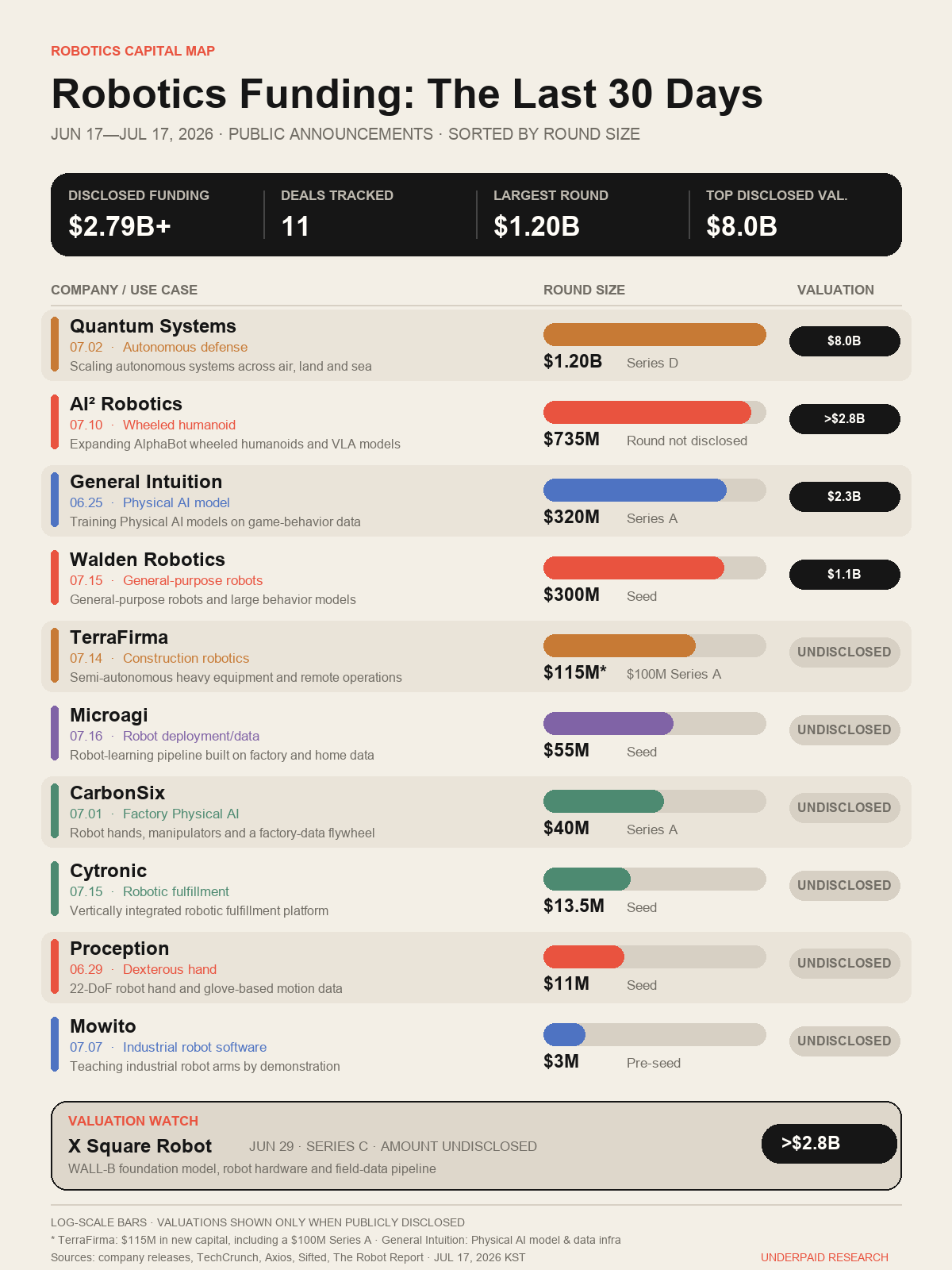
Round-size bars use a logarithmic scale so smaller seed financings remain visible. Valuations are shown only when publicly disclosed; undisclosed values were not estimated.
The headline number is highly concentrated
The four largest rounds—Quantum Systems, AI² Robotics, General Intuition, and Walden Robotics—accounted for $2.555 billion, or 91.5% of the disclosed total.
The two largest rounds alone accounted for 69.3%.
At the other end of the map, the five financings below $100 million totaled $122.5 million, only 4.4% of disclosed capital.
This is the first important read-through:
the period did not produce an evenly distributed rise in robotics financing. It produced a barbell market.
Large pools of capital went to companies attempting to build integrated platforms, large models, production capacity, or defensible field-data loops. Smaller checks funded narrower deployment and component wedges: dexterous hands, factory software, fulfillment operations, manipulation systems, and robot-learning infrastructure.
The map is a selected one-month dataset, not a complete census of every global robotics transaction. Its $2.79 billion total should therefore not be treated as the total size of the industry. The concentration inside the observed set is still useful because it shows how sharply disclosed dollars clustered around a few large bets.
Where the capital went
1. Integrated autonomy and production systems
Quantum Systems raised $1.2 billion in a Series D at a reported $8 billion valuation. Its scope extends beyond conventional industrial robotics into software-defined autonomous systems across air, land, and sea.
This is the largest deal in the map and also the broadest category exposure. It reflects demand for complete mission systems—not a standalone actuator, model, or robot body.
2. General-purpose bodies plus intelligence
AI² Robotics raised approximately $735 million to expand its AlphaBot wheeled-humanoid platform and VLA work.
Walden Robotics launched from stealth with a $300 million seed round and a reported $1.1 billion valuation, pairing general-purpose robots with large behavior models and citing Toyota production environments as an early deployment context.
The shared thesis is that the investable asset is not the body alone. It is the combination of hardware, behavior models, task data, deployment access, and the capital required to iterate all four together.
3. Physical AI models can attract platform-scale capital without manufacturing robots
General Intuition raised $320 million at a reported $2.3 billion valuation. It is not primarily a robot manufacturer. Its thesis is that large-scale game-behavior data can train models for agents and real-world Physical AI.
This matters structurally. Capital is not flowing only toward OEMs. Investors are also underwriting the intelligence and data layers that may sit across multiple robot embodiments.
Microagi occupies a related but more deployment-oriented position: building robot-learning pipelines from factory and home task data.
4. Smaller rounds target expensive integration bottlenecks
The smaller financings are not random software bets.
- TerraFirma combines heavy-equipment modification, semi-autonomy, and remote operations.
- CarbonSix is building manipulation hardware and a factory-data loop.
- Cytronic is pursuing vertically integrated robotic fulfillment.
- Proception combines a 22-degree-of-freedom hand with glove-based motion-data collection.
- Mowito is teaching industrial robot arms through demonstration rather than conventional programming.
These companies sit closer to the practical friction of deployment: retrofitting equipment, collecting task data, handling objects, integrating workflows, and reducing the amount of custom code required for each installation.
X Square Robot is shown separately because the Series C amount was not disclosed. Its reported $2.8 billion-plus valuation places it in the same platform discussion, but mixing an unknown round size into the funding bars would create false precision.
What investors appear to be underwriting
Capital intensity is becoming part of the moat
Robotics companies need more than model-training compute. They may need robot fleets, manufacturing lines, test facilities, spare parts, field-service teams, teleoperation infrastructure, safety engineering, and long deployment cycles before revenue scales.
That makes financing capacity strategically relevant.
A large balance sheet can buy iteration time, production tooling, customer support, data collection, and the inventory needed to move from a prototype to a fleet. In Physical AI, runway can become an engineering capability.
The reverse is also true: large rounds increase the proof burden. More capital does not automatically create reliable hardware, positive unit economics, or repeat customers.
Vertical integration still carries a premium
Several of the largest financings bundle layers that would be separate in a mature industry:
- robot or autonomous-system hardware
- foundation or behavior models
- task-data collection
- deployment access
- manufacturing and field operations
That is consistent with an immature stack. When interfaces, safety standards, data formats, and procurement patterns are not yet stable, companies cannot always rely on a modular supplier ecosystem. They integrate more of the stack themselves.
If the category matures, some of those layers may separate into specialist markets. For now, capital is rewarding teams that claim they can coordinate the whole system.
Deployment evidence is beginning to matter more than embodiment labels
The funded set includes drones, wheeled humanoids, general-purpose robots, construction systems, hands, fulfillment platforms, and model infrastructure.
The common denominator is not humanoid form.
It is the attempt to convert intelligence into useful physical work under real constraints. The stronger financing narratives increasingly include a customer environment, a data loop, a production plan, or a defined operational workflow.
That is healthier than funding based only on a polished demo, but most of the evidence remains company-reported and requires independent validation.
What the map does not prove
A financing round is evidence of investor demand, not proof of commercial success.
The map does not establish:
- recurring revenue or gross-margin quality
- fleet uptime or intervention rates
- customer concentration or repeat deployments
- manufacturing yield or warranty burden
- burn rate and future dilution
- whether private valuations can be realized in a later financing or exit
- whether announced deployment relationships are paid, scaled, or still exploratory
The category boundaries also matter. Quantum Systems is a defense-autonomy and drone company with a broader scope than industrial robotics. General Intuition is a Physical AI model and data company rather than a robot OEM. Combining them is useful for tracking the broader flow of capital into machines that perceive, decide, and act, but it should not erase those differences.
Value-chain read-through
In Robotics Radar’s 17-layer framework, the largest rounds cluster around Robot Body, Foundation Models, Data, Applications, Deployment & Integration, Manufacturing, and the Commercial Layer.
The smaller rounds touch Dexterous Hands, Control, Teleoperation, Data Collection, Industrial Software, and System Integration.
The funding asymmetry should not be read as proof that the largest platform layers will capture all future value. A small component or deployment company can still control a hard bottleneck. Round size measures available capital; it does not measure technical indispensability or eventual value capture.
The more durable signal is that investors are financing both ends of the stack:
- large integrated platforms that need enough capital to build bodies, models, fleets, and production systems; and
- specialized bottleneck companies that reduce the cost of manipulation, integration, data collection, and task deployment.
The middle may become difficult. A company that is neither a scaled platform nor the owner of a scarce technical or deployment wedge may struggle to justify robotics-level capital intensity.
What to watch next
The next useful evidence is not another funding announcement.
Watch for:
- how much capital is allocated to production capacity versus research and hiring
- paid deployments, repeat orders, and customer concentration
- fleet size in actual operating environments
- uptime, intervention rate, cycle time, and safety incidents
- manufacturing yield, service cost, and warranty reserves
- whether field data measurably improves task coverage and deployment speed
- whether large model and data companies can serve multiple embodiments
- whether specialist component and integration companies become suppliers to several OEMs
- how quickly companies return to the market for additional capital
- down rounds, secondary-sale discounts, or valuation resets that reveal the quality of prior marks
Interpretation
The one-month funding map is best understood as evidence of a barbell market.
At one end, investors are making very large bets on integrated autonomy, general-purpose robotics, and Physical AI platforms. At the other, smaller teams are attacking specific bottlenecks in hands, data, deployment, fulfillment, construction, and industrial programming.
This does not mean the robotics market has been broadly de-risked.
It means capital is becoming more selective about what it is willing to fund at scale.
The emerging premium appears to sit with companies that can claim one of two positions:
- enough integration, deployment access, and capital to build a platform; or
- ownership of a narrow bottleneck that several platforms will need.
The decisive test comes after the round closes.
Can the company convert financial runway into safe, repeatable deployments, proprietary operating data, manufacturing competence, and customer economics before the next financing becomes necessary?
That is the metric that will separate a robotics funding cycle from a durable robotics industry.
Not investment advice. Research notes only.